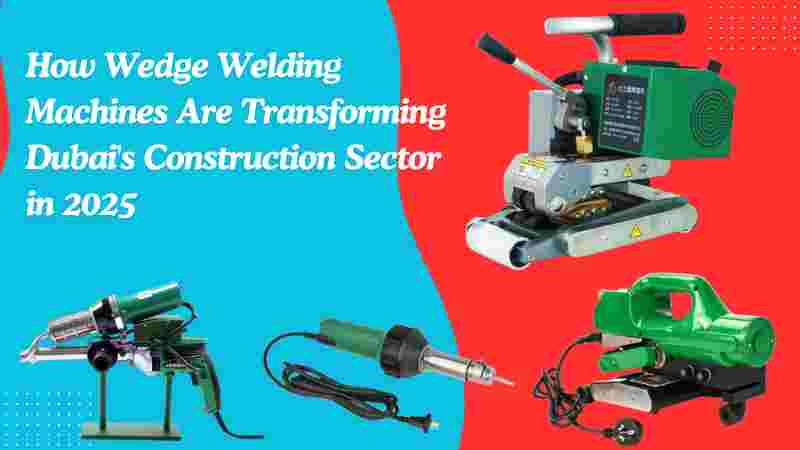
Dubai’s construction landscape in 2025 stands as a testament to innovation, sustainability, and technological advancement. As the emirate pushes forward with ambitious projects under the Dubai Economic Agenda D33 and various smart city initiatives, one technology has quietly revolutionized how buildings are waterproofed, sealed, and protected: wedge welding machines. This advanced thermoplastic joining technology is reshaping construction methodologies across the emirate, delivering unprecedented quality, efficiency, and environmental benefits.
The Evolution of Construction Technology in Dubai
Dubai has always been at the forefront of adopting cutting-edge construction technologies. From the world’s tallest building, Burj Khalifa, to the ambitious Dubai Creek Tower project, the emirate consistently demonstrates its commitment to pushing architectural boundaries. In 2025, this innovation extends beyond structural engineering to encompass every aspect of building envelope protection, where wedge welding technology plays an increasingly critical role.
Traditional construction methods relied heavily on adhesives, torch-applied systems, and mechanical fastening for waterproofing and membrane installation. These approaches, while functional, presented challenges in Dubai’s extreme climate, including inconsistent quality, longer installation times, and vulnerability to the region’s intense UV radiation and temperature fluctuations exceeding 50°C during summer months.
Why Wedge Welding Has Become Essential
Addressing Dubai’s Unique Climate Challenges
Dubai’s construction sector faces environmental conditions that test the limits of building materials. The combination of extreme heat, high humidity, occasional sandstorms, and intense solar radiation requires waterproofing solutions that can withstand decades of exposure without degradation. Wedge welding creates molecular bonds between thermoplastic membranes, producing seams that often exceed the strength of the base material itself.
Unlike adhesive-based systems that can fail due to heat exposure or chemical breakdown, wedge-welded seams maintain their integrity throughout the material’s service life. This reliability has made the technology indispensable for high-profile developments where failure is not an option.
Meeting Sustainability Goals
The UAE’s commitment to sustainability, exemplified by initiatives like the Dubai Clean Energy Strategy 2050 and the net-zero by 2050 strategic initiative, has pushed the construction sector toward more environmentally responsible practices. Wedge welding aligns perfectly with these goals by eliminating solvent-based adhesives, reducing volatile organic compound (VOC) emissions, and creating recyclable joining systems.
Modern thermoplastic membranes joined by wedge welding can be fully recycled at the end of their service life, contributing to circular economy principles that Dubai is actively promoting. This environmental advantage has made wedge welding the preferred method for projects seeking LEED certification, BREEAM ratings, or Estidama Pearl ratings commonly required in UAE developments.
Key Applications Reshaping Dubai Construction
Commercial Roofing Systems
Dubai’s commercial construction boom continues unabated in 2025, with new office towers, shopping complexes, and mixed-use developments transforming districts like Dubai Marina, Business Bay, and Dubai South. Single-ply roofing membranes, particularly TPO (thermoplastic polyolefin) and PVC (polyvinyl chloride), have become the standard for these projects.
Wedge welding machines enable contractors to install these roofing systems rapidly and reliably, creating watertight barriers that protect buildings from seasonal rainfall and the occasional extreme weather events that have become more frequent. The technology’s speed advantage is particularly valuable in Dubai’s construction market, where project timelines are aggressive and delays carry significant financial penalties.
Below-Grade Waterproofing
The expansion of Dubai Metro, underground parking structures, and basement developments in areas with high water tables has created unprecedented demand for reliable below-grade waterproofing. HDPE (high-density polyethylene) and LLDPE (linear low-density polyethylene) geomembranes, joined using wedge welding technology, provide impermeable barriers protecting structures from groundwater intrusion.
Projects like the Dubai Metro Route 2020 extension and numerous high-rise developments in areas prone to groundwater pressure rely on wedge-welded waterproofing systems. The technology’s ability to create consistent, testable seams provides the quality assurance that foundation waterproofing demands.
Green Roof and Landscape Architecture
Dubai’s increasing emphasis on green building design has led to a proliferation of vegetated roofs, rooftop gardens, and integrated landscape features in urban developments. These installations require sophisticated waterproofing systems that prevent root penetration while managing irrigation water and drainage.
Wedge welding technology enables the installation of root-resistant membranes with superior seam integrity, essential for protecting the building structure below while supporting vegetation above. Developments like The Sustainable City Dubai and various DEWA (Dubai Electricity and Water Authority) green building initiatives showcase these applications.
Water Management Infrastructure
Water scarcity remains a critical challenge for the UAE, driving investment in water storage, treatment, and conservation infrastructure. Wedge-welded geomembranes line reservoirs, retention ponds, and treatment facility tanks throughout Dubai, ensuring precious water resources are contained without loss.
The Dubai Municipality’s water conservation projects and agricultural initiatives in areas like Hatta increasingly rely on synthetic lining systems joined with hot wedge technology. These installations must meet rigorous quality standards, making equipment reliability and seam testing capabilities paramount.
Technology Advancements Driving Adoption
Automated Quality Control Systems
Modern wedge welding machines available through leading Dubai wedge welding equipment supplier networks feature sophisticated monitoring systems that continuously track welding temperature, speed, and pressure. These parameters are recorded digitally, creating permanent quality documentation that satisfies increasingly stringent building authority requirements.
Real-time monitoring alerts operators immediately if parameters drift outside acceptable ranges, preventing defective welds before they occur. This proactive quality control has significantly reduced callback rates and warranty claims for contractors adopting the technology.
Integration with Building Information Modeling (BIM)
Dubai’s construction sector has rapidly adopted BIM workflows, with many projects now requiring digital modeling from design through construction and facility management. Advanced welding equipment now integrates with BIM systems, allowing precise tracking of membrane installation progress and automated generation of as-built documentation.
This integration streamlines project management, facilitates coordination between trades, and provides building owners with comprehensive digital records of waterproofing installations for future maintenance planning.
Mobile and Compact Equipment Solutions
While large automated welding machines serve high-volume applications, the development of portable, battery-powered units has expanded wedge welding’s applicability to repair work, small-scale projects, and challenging access situations common in Dubai’s urban environment.
These portable units maintain the quality standards of their larger counterparts while offering the flexibility contractors need for renovation projects in occupied buildings or installations in space-constrained locations.
Complementary Technologies in Modern Construction
While wedge welding excels for long seams and large area coverage, comprehensive waterproofing projects require multiple technologies working in concert:
Extrusion Welding for Detail Work
Complex geometries, penetrations, and termination details often require hot air extrusion welding to achieve proper sealing. This complementary technology uses heated air and thermoplastic welding rods to create watertight connections where wedge welding equipment cannot reach. Progressive contractors partner with an experienced extrusion welder distributor in UAE to ensure their teams have access to complete toolsets for any waterproofing challenge.
Hot Air Welding for Repairs and Patches
Field repairs and membrane patches benefit from hand-held hot air welding tools that provide precision and control in small areas. These tools complement wedge welding systems, creating comprehensive capabilities for installation teams.
Economic Impact on Dubai’s Construction Industry
Reduced Installation Time and Labor Costs
Wedge welding machines can achieve welding speeds exceeding 12 meters per minute under optimal conditions, dramatically reducing installation time compared to traditional methods. On large roofing projects spanning thousands of square meters, this efficiency translates to weeks of saved time and proportional reductions in labor costs.
In Dubai’s competitive construction market, contractors who have invested in modern welding technology consistently underbid competitors still relying on older methods while maintaining healthy profit margins.
Lower Warranty Claims and Maintenance Costs
The superior seam strength and consistency achieved through wedge welding reduces long-term maintenance requirements and warranty callbacks. Building owners benefit from extended system service life, often exceeding 30 years for properly installed thermoplastic membranes, compared to 15-20 years for some alternative systems.
This longevity consideration has influenced specification decisions across Dubai’s construction sector, with developers increasingly mandating welded thermoplastic systems for their projects.
Workforce Development and Skill Enhancement
The adoption of advanced welding technology has created new career pathways for construction workers in Dubai. Training programs offered by equipment manufacturers and technical institutes like Dubai Technology and Media Free Zone colleges have developed a skilled workforce capable of operating sophisticated equipment and maintaining quality standards.
This skill development aligns with the UAE’s broader Emiratization goals and contributes to the construction sector’s professionalization.
Regulatory Environment and Quality Standards
Dubai Municipality and various free zone authorities have progressively updated building codes and standards to reflect advances in waterproofing technology. The adoption of international standards including ASTM International specifications and European Norm (EN) standards has created a framework that favors proven technologies like wedge welding.
Projects seeking government approvals or operating within free zones like Dubai South must demonstrate compliance with these standards, creating market pressure for quality equipment and proper installation practices. Third-party testing and certification of welded seams has become standard practice on major projects, with peel tests and air pressure tests verifying seam integrity.
Future Outlook for Construction Technology
As Dubai prepares for Expo City Dubai’s ongoing development and looks toward hosting World Expo 2040 in the Dubai South area, the construction sector’s technological sophistication will continue advancing. Several trends are emerging:
Artificial Intelligence and Machine Learning
Next-generation welding equipment will incorporate AI algorithms that optimize welding parameters in real-time based on ambient conditions, material characteristics, and historical performance data. These systems will further reduce operator skill requirements while improving consistency.
Robotics and Automation
Autonomous welding robots capable of navigating roof surfaces and performing installations with minimal human intervention are already in development. Dubai’s construction sector, known for embracing automation, will likely see early adoption of these technologies.
Enhanced Material Science
Ongoing research into thermoplastic membrane formulations specifically engineered for extreme climates promises even better performance in Dubai’s challenging environment. These materials will be optimized for welding, expanding the applications where hot wedge technology provides the best solution.
Conclusion
Wedge welding technology has fundamentally transformed how Dubai’s construction sector approaches waterproofing, envelope protection, and sustainability. The combination of superior performance, environmental benefits, economic advantages, and alignment with the emirate’s quality standards has made this technology essential for modern construction projects.
As Dubai continues its remarkable development journey, the construction sector’s embrace of advanced joining technologies like wedge welding demonstrates the emirate’s commitment to building infrastructure that meets the highest global standards while addressing unique regional challenges. For contractors, developers, and building owners, investing in proper equipment and training for these technologies is no longer optional—it’s essential for remaining competitive in one of the world’s most dynamic construction markets.